

Hosting Ollama in the Cloud: The Queue-First Architecture
Part 1: Why Host Ollama on AWS?
Hosting Ollama on AWS to run models like Gemma offers three compelling advantages for internal applications.
Data Privacy and Control
For government work, healthcare, financial services, or any organization handling sensitive data, sending information to third-party APIs creates compliance and privacy risks. Self-hosting keeps your data entirely within your infrastructure.
Stop Paying Per Token
Token-based pricing bleeds budgets dry — and the bill only grows as your usage does. Self-hosting flips the model: fixed infrastructure costs, unlimited requests, zero surprises. At scale, you're not just saving money — you're escaping a pricing trap.
Customization and Flexibility
You control which models run, can fine-tune on proprietary data, and integrate however your architecture requires. No vendor limitations, no API rate limits, no dependency on external service availability.
The trade-off is operational overhead—you're managing infrastructure instead of making simple API calls. For organizations with existing cloud operations and DevOps capability, this trade-off makes sense when privacy, cost, or control matter more than convenience.
Part 2: AWS Hosting Options for Ollama + Gemma
There are two fundamental approaches to hosting Ollama on AWS, each optimized for different priorities.
Option A: Always-On Real-Time Infrastructure
Deploy Ollama on GPU-equipped EC2 instances (g4dn or g5 series) that run continuously. Applications make direct HTTP calls to the Ollama API and receive immediate responses. LangFlow sits in front of Ollama to orchestrate workflows and provide clean APIs to internal applications.
This architecture is simple and responsive—users get instant answers. The instance runs 24/7, model stays loaded in memory, and latency stays low. You're paying for continuous availability whether processing one request per hour or one hundred.
Best for: Truly interactive use cases where humans are waiting for responses—chatbots, real-time dashboards, live customer service tools. When sub-second latency directly impacts user experience.
Option B: Queue-Based Elastic Infrastructure
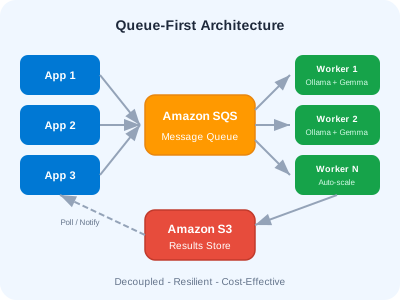
Applications post requests to Amazon SQS rather than calling Ollama directly. Worker instances pull jobs from the queue, process them via Ollama, and write results to S3 or a database. Workers can auto-scale based on queue depth and shut down when idle.
This architecture trades immediate response for cost efficiency and resilience. Requests might wait seconds to minutes depending on queue depth, but infrastructure scales with actual demand and costs track real usage. When there's no work, you pay for storage and queue, not idle GPU instances.
Best for: Background processing, batch document analysis, scheduled tasks—and honestly? Almost everything else too. Most internal LLM workloads belong in a queue once you strip away the assumption that everything needs to be instant. In Part 3 of this series, we'll make the case that queues should be your default—and that "real-time" is an expensive illusion most teams don't actually need.
The Reality: Most teams assume they need real-time infrastructure because requests come from users. But "user-initiated" doesn't mean "user is actively waiting." Document analysis triggered by upload, reports generated after data submission, background enrichment of records—these can all tolerate queue-based processing if you set expectations correctly.
Part 3: Queue Everything (Even Fast Requests)
Here's the counterintuitive insight: even if you need fast responses, routing everything through a queue provides architectural benefits that outweigh the minimal added latency.
Decoupling as Architecture Principle
When applications call Ollama directly, they're tightly coupled to infrastructure availability. If the Ollama instance restarts, fails, or needs maintenance, every calling application experiences immediate errors. The failure propagates instantly.
A queue decouples requesters from processors. Applications post jobs and move on. Workers process jobs whenever they're available. If a worker crashes mid-processing, the job returns to the queue and another worker handles it. If all workers are down temporarily, jobs accumulate safely in the queue until workers restart. Applications never see infrastructure failures—they just see varying response times.
Fast Queue Processing Is Still Fast
A well-configured queue adds minimal latency. SQS delivers messages in milliseconds. A worker polling the queue picks up jobs nearly instantly. If your worker processes a request in 2 seconds and returns results to S3, the total time might be 2.5 seconds versus 2 seconds for direct API calls. For internal applications, this difference is negligible.
The perception that queues mean "slow" comes from architectures that under-provision workers or use long polling intervals. With adequate worker capacity and aggressive polling (or event-driven triggers), queue-based processing feels nearly real-time while providing queue benefits.
Resilience Benefits
Queue-first architecture naturally handles traffic spikes, failures, and scaling. Sudden burst of 1000 requests? They queue up and process in order rather than overwhelming your instance. Worker crashes during processing? Job returns to queue automatically. Need to deploy new model version? Drain the queue, update workers, resume processing—zero user-facing errors.
You also gain automatic retry logic, dead letter queues for problematic jobs, and complete visibility into system state. How many jobs are pending? How long are they waiting? Which jobs failed repeatedly? These questions have simple answers with queues, complex answers with direct API architectures.
Cost Optimization Comes Free
Once everything routes through queues, you can optimize worker infrastructure aggressively. Auto-scale based on queue depth. Use spot instances for additional cost savings (jobs just re-queue if instances terminate). Schedule workers to shut down during known quiet periods. The queue absorbs all this elasticity without impacting applications.
You can even implement priority queues: fast lane for urgent requests with dedicated workers, slow lane for background tasks with cheaper workers. Applications declare priority when submitting jobs, infrastructure routes accordingly.
Implementation Pattern
Applications submit all LLM requests to SQS with job ID, prompt, parameters, and result destination. Workers poll the queue aggressively (short wait times), process jobs via Ollama, write results to S3 keyed by job ID, and optionally publish completion notifications via SNS. Applications poll S3 for results or subscribe to notifications.
For the subset of truly interactive requests, provision enough workers to keep queue depth near zero during business hours. This provides real-time feel with queue resilience. For background requests, let queue depth grow and process with elastic capacity.
The Architecture Decision
Don't ask "do I need queues?" Ask "why wouldn't I use queues?" The decoupling, resilience, observability, and optimization benefits apply whether your target latency is 2 seconds or 2 minutes. The minimal latency overhead is worth the architectural advantages.
Start with queue-first architecture from day one. Provision workers generously if you need fast processing, scale conservatively if async is acceptable. But always put the queue in front of Ollama. You'll build a more resilient, observable, and cost-effective system than direct API architecture could ever provide.
Conclusion
Hosting Ollama on AWS makes sense when data privacy, cost at scale, or customization outweigh the convenience of commercial APIs. The infrastructure decision isn't GPU size or instance type—it's whether to embrace queue-based architecture.
Route everything through SQS, even requests that need fast responses. The decoupling provides resilience against failures, natural traffic buffering, automatic retry logic, and complete system observability. Fast queue processing adds negligible latency while delivering substantial architectural benefits.
Your applications become resilient to infrastructure failures. Your costs scale with actual demand. Your operations team gets visibility and control. And when requirements change—you need more capacity, want to try a different model, or must handle traffic spikes—the queue-based architecture adapts easily.
The simplest, most reliable way to host Ollama on AWS is to put a queue in front of it and never look back.
Need help designing your self-hosted LLM infrastructure? Let's discuss your architecture.